
Small businesses are affected from 2026.
Even if mandatory issuing only begins for them in 2027, they must be able to receive electronic invoices and have appointed at least one PA by 1 September 2026.
From billable work to collection, Tempolia prepares and checks your invoices, then sends them through the government-approved platform (PA) of your choice when the selected connection supports it. Keep your processes and accounting software while tracking submissions, statuses, rejections and payments.

The invoice must contain structured data, be routed by an approved platform and generate actionable statuses. Factur-X retains the readable document while placing it in a controlled workflow.
Even if mandatory issuing only begins for them in 2027, they must be able to receive electronic invoices and have appointed at least one PA by 1 September 2026.
Tempolia builds the invoice from your work, checks the data and displays status updates and rejection reasons. The approved platform delivers the invoice to the customer’s platform and sends the required regulatory data to the French tax authority.
French tax authority: the PA transmits the required invoice, transaction and payment data.
Tempolia gives you the freedom to work with all the main PAs in France. Its technical foundation supports easy connections to any PA through Factur-X Extended, CII, UBL and AFNOR flows. A PA can be connected when its documentation and technical interface are available.
Supplier invoices: your receiving PA receives supplier invoices; they are then processed in your accounting or purchasing system. Tempolia remains the system of record for customer invoices, payments and business data.
Compliance becomes part of your existing invoicing cycle instead of creating a separate tool.
Clean customer data, then pull through time, expenses, fixed fees, subscriptions, deposits or milestones.
Review lines, units, taxes, totals, mandatory information and routing references.
Lock the document, produce structured data, submit it to the PA and retain its identifier.
Synchronise statuses, correct issues and connect payments, reminders and accounting.
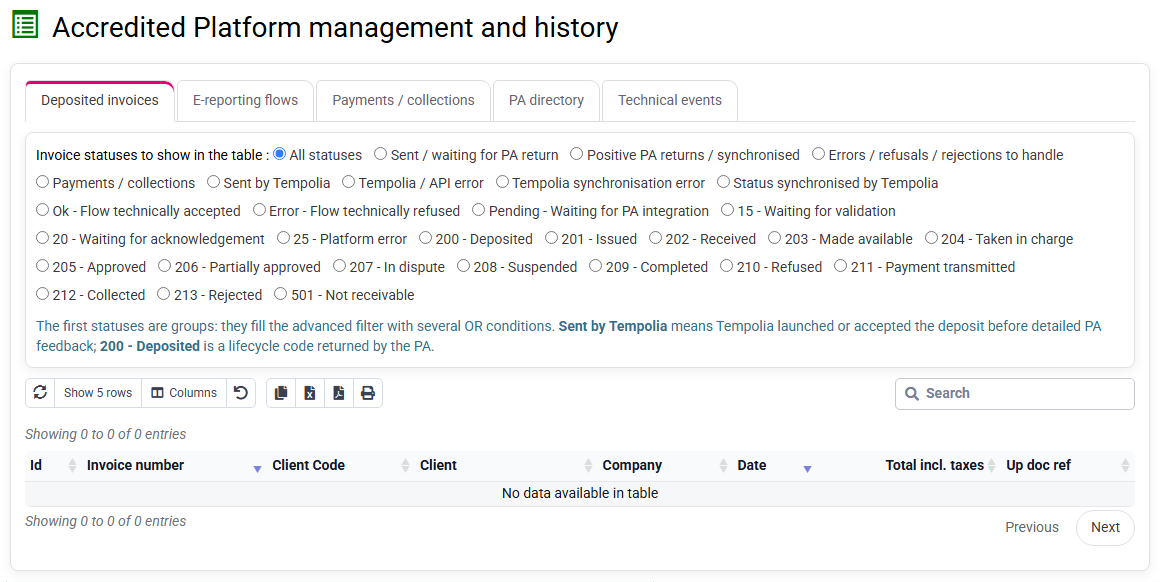
The submission or exchange identifiers returned by the PA connect every invoice to its lifecycle. The reason stays in the history so the correct source data can be addressed without losing track of collection.
Example cycle, depending on the workflow and statuses used:
The reason identifies the data to correct before resubmission: identifier, address, tax, total, format or routing.
The invoice was received, but the recipient refuses it definitively. A provisional disagreement may use a separate dispute status.
In-scope transactions between businesses established in France travel from PA to PA. Your customer may use a different platform.
In-scope B2C and international transactions feed e-reporting according to their nature and VAT treatment.
Where VAT is due on collection, the required payment data remains linked to the invoice and payment.

For public contracts, including engineering consultancy work, Tempolia prepares a Factur-X file using the specific profile required by Chorus Pro while retaining purchase order, contract and service references.
View the engineering workflow →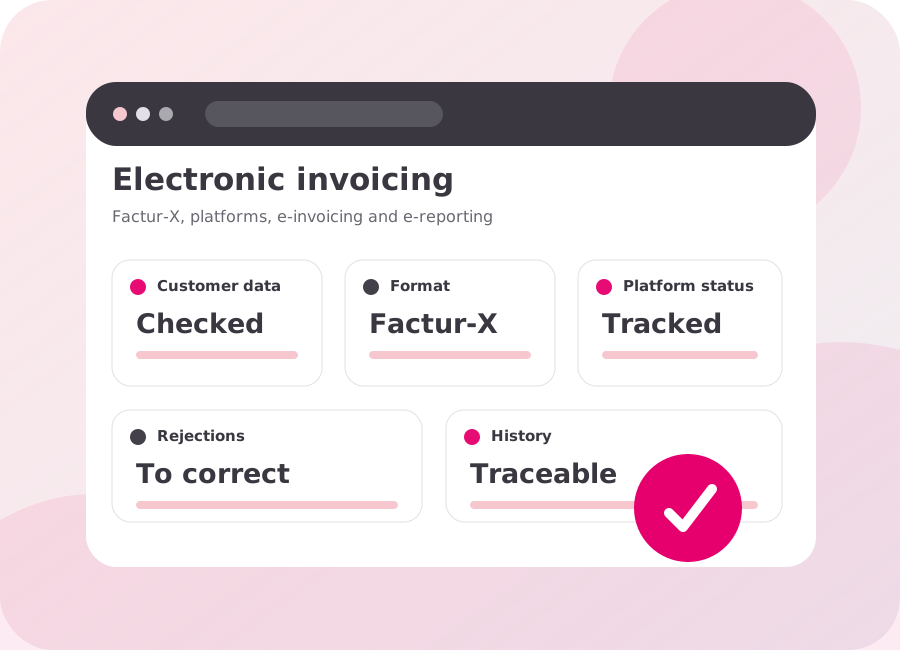
Factur-X combines the PDF with structured XML. Tempolia checks their consistency and prepares the other formats and flows required for the selected connection.
We work from your actual customers and invoices to secure the complete workflow, not just file generation.
Companies, SIREN/SIRET, VAT, countries, addresses, units and payment terms.
French B2B, B2C, international, public sector, deposits, credit notes and collections.
Direct connection, batch upload or routing through accounting software.
Invoices, directory lookups, submissions, statuses, rejections, refusals and payments.
Expected actions, responsibilities, corrections and daily monitoring.
Every business established in France and subject to French VAT, including businesses under the small-business VAT exemption scheme, must be able to receive electronic invoices from 1 September 2026. Large and mid-sized companies must also issue electronically and perform e-reporting from that date; SMEs and microbusinesses from 1 September 2027.
No, not under the new regulated workflow. The invoice must contain structured data and travel through an approved platform, which performs the required checks and returns the expected statuses. Factur-X combines a readable PDF with consistent XML; an ordinary PDF attached to an email provides neither this flow nor its monitoring.
Tempolia is the management and invoicing solution connected to the approved platform selected by the customer. Tempolia prepares and checks the invoice, exchanges the available data and documents, and displays statuses or rejections; the PA uses the directory, handles regulated delivery and sends the required information to the authorities.
Tempolia gives you the freedom to work with all the main PAs in France. Its technical foundation supports easy connections to any PA through Factur-X Extended, CII, UBL and AFNOR flows. A PA can be connected when its documentation and technical interface are available.
Yes. Approved platforms are designed to interoperate: your PA consults the directory and routes the invoice to the platform and receiving address declared by the customer. Company identifiers and addressing must therefore be reliable, after which submissions, statuses and any rejections are tested across the real workflow.
A rejected invoice did not pass a technical or functional platform check and must be corrected before it is submitted again. A refused invoice received a final decision from the recipient, while a temporary disagreement may use a dispute status. Tempolia retains the returned status and reason to guide processing.
Transactions outside domestic B2B e-invoicing feed the e-reporting sent to the PA. For services subject to VAT on collection, the required payment data is linked to the invoice and payment; transaction types, periods, tax and cancellation cases should be tested using the company’s real activity.
Chorus Pro remains the public-sector portal. For engineering firms and other public-sector suppliers, Tempolia generates a Factur-X file using the specific profile expected by Chorus Pro and retains the order, contract or service references required for submission. A trial checks the file, addressing and portal responses before launch.
The PA designated for reception receives supplier invoices, which are then processed in the accounting or purchasing system selected by the organisation. Tempolia remains the system of record for customer invoices, payments and business data; scoping therefore defines owners, interfaces and the information that must return to each system.
The workflow is validated with the PA using real invoices: directory checks, submission, statuses, rejections, refusals, payments and recovery after an error. B2B, B2C, international or public-sector variants are covered when relevant to the business. Responsibilities, response times and corrections are then explained before users access the flow.
Use the official sources below to check the requirements and deadlines that apply to your business.
| Date | Requirement | Businesses concerned |
|---|---|---|
| 1 September 2026 | Ability to receive electronic invoices | All in-scope taxable businesses established in France |
| 1 September 2026 | Electronic issue and e-reporting within the scope of the reform | Large businesses and intermediate-sized enterprises |
| 1 September 2027 | Electronic issue and e-reporting within the scope of the reform | SMEs and microbusinesses |
Tempolia prepares and transmits data and documents within its functional scope, receives statuses and retains an exchange history. The business remains responsible for addressing data, VAT rules, the selection and mandate of its approved platform and the handling of rejections and exceptions.
Last regulatory review: . French legislation and tax-authority information prevail in the event of any discrepancy.
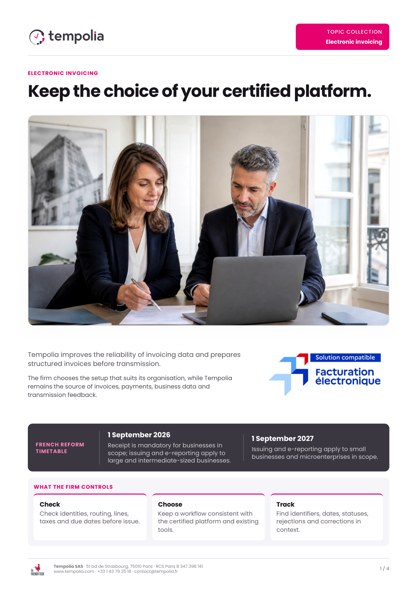 Topic Brochure
Data quality, Factur-X, certified platforms and the invoicing workflow.
Open the PDFWe test your invoicing sources, mandatory data, PA, statuses and accounting output on real cases.