Legal references and time limits must be checked against the rules applicable when they are used.
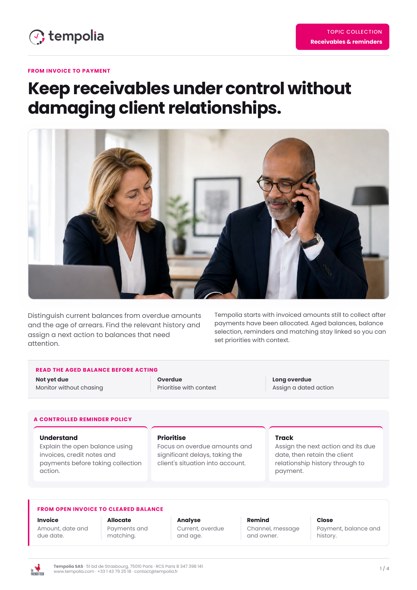
Late customer payments are common in every business. Careful management of customer receivables is essential to prevent them from affecting your cash flow too severely. It is a key indicator of your financial position.
Effective management helps maintain stable cash flow and minimise the risk of late payment. Aged receivables play a central role in this process.
What are aged receivables?
An aged receivables report sorts issued invoices that remain unpaid according to their age. It divides receivables into age bands, for example: 0–30 days, 31–60 days, 61–90 days and more than 90 days. Each band shows how long invoices have been outstanding. This gives you an at-a-glance view of how long every invoice has been due, making overdue payment tracking easier.
Under Article L441 of the French Commercial Code, the statutory payment period is, in principle and by default, 30 days from receipt of the goods or performance of the service.
Structure of an aged receivables report
A typical aged receivables report contains the following information:
- customer name;
- total amount due;
- breakdown by age band: amounts due in each band — 0–30 days, 31–60 days and so on.
Using aged receivables effectively allows you to prioritise collection efforts and implement reminder strategies tailored to each age band.

Why are aged receivables important?
They improve cash-flow management
Well-maintained aged receivables support better day-to-day cash-flow management. By identifying late payments quickly, you can anticipate liquidity problems and take steps to prevent them. This helps maintain positive cash flow by reducing working capital requirements, thereby increasing the business's long-term resilience.
They reduce the risk of bad debts
By reviewing aged receivables regularly, you can act quickly with customers that are slow to pay. The older a receivable becomes, the harder it is to settle. Taking practical action reduces the risk that bad debts will have to be written off.
The payment period must not exceed 90 days from the invoice issue date. Where statutory payment periods are not observed, Article L441-10 of the French Commercial Code provides for penalties.
They improve customer relationships
Aged receivables also help you maintain good customer relationships. By identifying late payments quickly, you can start constructive discussions with customers to understand the reasons and find flexible solutions. This human, respectful approach reinforces trust and proximity in customer relationships.
How can you use aged receivables for more effective reminders?
Strategic analysis of aged receivables
Review your aged receivables regularly, ideally every week. A frequent overview helps you anticipate problems and act accordingly. Classify customers by their payment habits to anticipate risk.
The working capital requirement (WCR) is an essential metric in the strategic analysis of aged receivables because it quantifies the resources required to finance the operating cycle.
Well-maintained aged receivables quickly identify overdue customer debts, which can directly affect WCR. By shortening payment times and optimising receivables management, a business can reduce its WCR and improve cash flow. Effective use of aged receivables supports the business's financial sustainability by maintaining positive cash flow.
Tailored reminders
Tailor reminders according to the age of each debt. For recent receivables — 0–30 days — a polite email reminder may be enough. For older receivables — 31–60 days — a letter or telephone call may be required. For very old receivables — more than 90 days — consider firmer action such as sending a registered letter.
Using management and invoicing software
Internal management and invoicing software includes aged receivables features. A tool such as Tempolia automates receivables analysis and segmentation. Setting up reminders helps prevent debts from lingering and enables prompt, automatic customer follow-up.
Proactive customer communication
Use aged receivables as a starting point for open communication with customers. Instead of waiting until invoices become bad debts, contact customers as soon as you notice a delay. A proactive approach shows customers that you take receivables management seriously, which may encourage them to settle invoices more quickly.
Conclusion
Aged receivables are a comprehensive tool for improving the effectiveness of customer reminders. By analysing them regularly, segmenting customers, tailoring reminders and using management software such as Tempolia, you can significantly improve receivables management. This helps maintain healthy cash flow, reduce the risk of bad debts and strengthen customer relationships.
Adopt these good practices to optimise your collection process and support your business's financial sustainability.
Measure payment time and segment reminders
The aged receivables report is a snapshot of balances. To monitor the trend, add a payment-time measure with a consistent scope: simple DSO = gross trade receivables ÷ gross revenue for the period × days in the period. With €300,000 of receivables and €2.4 million of gross annual revenue, DSO is 45.6 days. This method is sensitive to seasonality; a count-back method is preferable where revenue varies materially.
| Segment | Action | Control |
|---|---|---|
| Before due date | Preventive reminder at D−3 for sensitive accounts | Invoice received and no known dispute |
| 1 to 7 days | Courteous email with invoice copy | Due date, contact and payment in transit |
| 8 to 30 days | Personal reminder and call for material amounts | Dated promise to pay |
| 31 to 60 days | Escalate to the account owner | Dispute, credit note, payment plan or service hold |
| Over 60 days | Formal collection decision | Complete history and internal policy |
Also segment by amount, risk, age, owner and reason. A disputed invoice should not follow the same path as an oversight: assign an owner and next action to every exception.

See also: automating billing in an accounting firm.