The Tempolia usage figures mentioned in the text reflect the position at the publication date.
Client case study summary
Tempolia faced two challenges:
- Bank-feed management: a time-consuming manual process that caused errors and wasted time.
- Client expectations: growing demand for reliable, easy-to-use automation.
Bridge’s proposed solution: integrating Bridge’s bank reconciliation solution automated the retrieval of bank feeds, improved the accuracy of accounting entries and optimised financial management for Tempolia clients.
Key figures
- 90% of payment retrieval and matching automated.
- 95% fewer errors.
- More than three working days saved each month.

The requirement
Automating bank-feed management and improving its reliability
A few words about Tempolia
Tempolia is time management, billing and activity monitoring software specialising in planning and billing. Designed to simplify companies’ internal management, it provides precise monitoring of working time and automated billing.
Its main clients are accounting firms, law firms, engineering consultancies and any company that needs detailed working-time monitoring and automated billing.
As Tempolia was part of the Advisto group, its tool was then used daily by 6,500 users to manage 220,000 clients.
Tempolia’s challenge
Before integrating Bridge, Tempolia faced a major challenge: making the retrieval and recording of bank feeds smoother and more reliable.
Automating the collection of bank transactions was essential to save time and reduce the risk of data entry errors.
Tempolia’s expectations of a solution such as Bridge were clear:
- Reduce the time spent entering bank feeds manually.
- Ensure the reliability of recorded data.
- Optimise resources by limiting manual tasks.
The solution
Smooth, rapid automation with Bridge
The solution proposed by the Bridge teams
Drawing on its expertise in optimising financial flows, the Bridge team quickly identified Tempolia’s requirements and proposed a suitable solution.
The collection of bank feeds through Bridge was integrated into Tempolia’s management platform, fully automating the process.
With a straightforward API that was quick to implement, the solution was integrated in record time without disrupting ongoing operations.
This automation now enables Tempolia clients to:
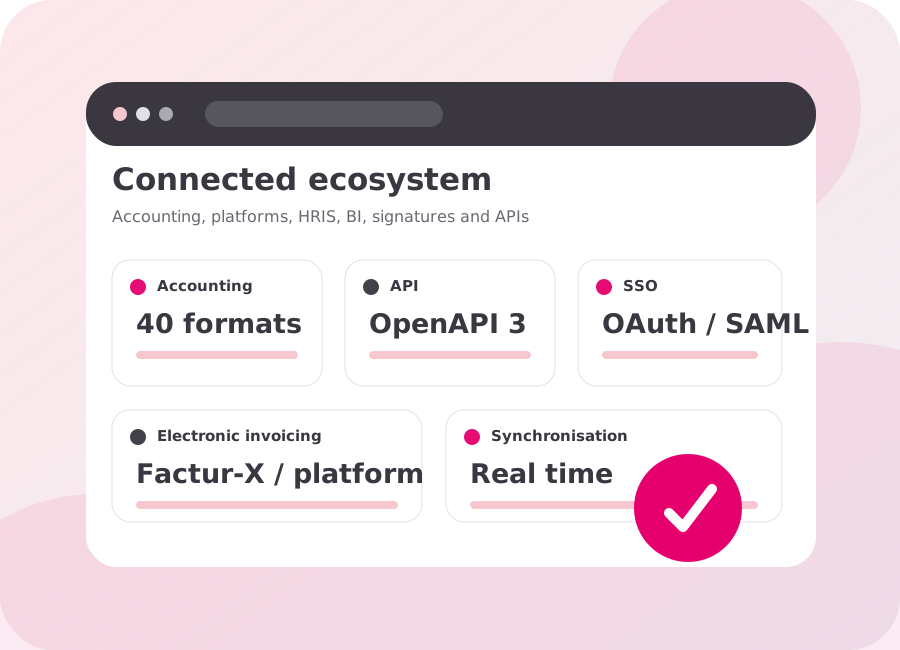
- Connect to their bank accounts directly through Bridge’s secure interface.
- Retrieve bank transactions automatically and reconcile them with the corresponding invoices.
- Match and settle payments in a single click, avoiding errors and repetitive tasks.
The smooth integration of the Bridge solution enabled Tempolia to deliver a better user experience while optimising its clients’ accounting and financial management.
The outcome
Time savings and greater reliability
The Bridge integration delivered significant benefits to Tempolia and its clients.
“This partnership has demonstrated that automation and connections with other industry-specific tools are priorities to develop in order to improve our clients’ productivity and satisfaction.”
Tempolia clients welcomed this automation for its direct impact on productivity and on the reliability and security of recorded data.
How the Bridge results were measured
| Scope | Retrieval of bank transactions and matching with invoices for Tempolia users covered by the integration. |
|---|---|
| Starting point | Manual collection and recording described as time-consuming and error-prone. |
| Period | Bridge case study dated 1 April 2025. The observation period and exact deployment date are not published. |
| Method | Figures reported in the Bridge supplier case study; sample, denominators and detailed protocol were not published. |
| Reported outcomes | 90% of payment retrieval and matching automated, 95% fewer errors and more than three working days saved per month. |
These are reported indicators for the studied case, not a guaranteed benchmark for every client. Benefits depend on the number of accounts and transactions, automatic matching rate and previous process. For a local measure, compare transaction count, automatic matches, corrections and processing time for four weeks over a stable scope.
Primary source: Tempolia customer case published by Bridge.
See also: improving reminders with aged receivables and automating billing in an accounting firm.