Seregec, an accounting firm and member of the Philéo group, has been using Tempolia for several years to track time and activity and manage billing.
Chloé Barat, a chartered accountant and partner, discusses the solution’s importance to the firm’s organisation and profitability, as well as the benefits it provides to staff.

Could you briefly introduce Seregec and its business?
Seregec is an accounting firm within the Philéo group. We have around one hundred staff and support a wide variety of clients, ranging from sole traders to companies with several dozen employees. We have historically specialised in property development and the hospitality sector—hotels, cafés and restaurants—but we work with a highly diverse range of businesses.
How long have you been using Tempolia, and for what purposes?
When I joined the firm in 2017, we were already using Tempolia, which was then called Temps 2000. We used it primarily for client billing and time entry. We gradually added other features, particularly the management of tax, accounting and social-security deadlines, which has become a real asset to our organisation.
Why did you choose Tempolia rather than the time management module offered by your main accounting software?
Our main accounting software does offer a time management module, but we have always been satisfied with Tempolia, the software is constantly improving, and we prefer not to put all our eggs in one basket. Tempolia gives us a clear, detailed view of our billing and of the time spent on each engagement. It provides precise monitoring of the costs and profitability of our work, which is essential for managing the firm.
How do you use Tempolia to monitor engagement profitability?
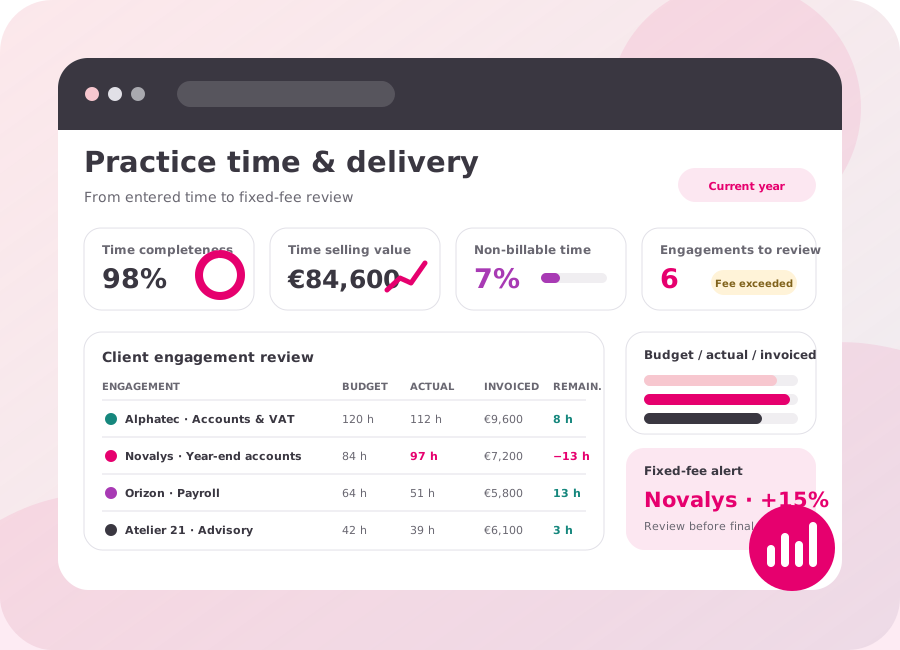
Tempolia lets us register our clients with budgets spanning several years, which are automatically converted into monthly, quarterly or annual invoices. At the same time, our staff enter the time they spend each day.
This gives us real-time profitability analysis for each engagement. We can quickly identify the clients on whom we make a margin and, conversely, those who cost us more than they generate.
Do you use this data in your client relationships?
Absolutely. We share the results with our clients when presenting their annual accounts. We show them what we have billed and the time actually spent on their work. This enables us to be completely transparent and, where necessary, adjust our fees.
We can also identify clients who request a great deal of advice that is not included in their package and offer them a more suitable service.
Could you explain in more detail how Tempolia helps you optimise deadline management?
Since January 2025, we have indeed been using a custom deadline management module developed with Tempolia.
All our staff can access a list of their engagements, with the dates of the main tax, social-security and legal filings to be completed. This helps us stay better organised and reduce the risk of anything being overlooked.
How do your staff view Tempolia?
At first, as with any change of tool, there was some reluctance. But Tempolia’s user-friendly design and ease of use quickly won everyone over. It gives staff a clear view of their work, helps them organise it more effectively and prevents overruns on certain engagements.
It also plays an important role in annual appraisals, because we can analyse time by engagement and adjust workloads accordingly.
Finally, what do you see as Tempolia’s main strengths?
Its flexibility and reliability. We have never had a technical issue with Tempolia in ten years of use.
In addition, Gilles Boussin, Tempolia’s CEO, is highly responsive and able to develop bespoke features based on our requirements. That is a genuine advantage over more rigid solutions.
Today, Tempolia has become an essential ERP system for us, centralising all the information we need to manage our firm.
Understanding Seregec’s results
| Scope | Seregec, an accounting firm with around 100 staff, covering the stated uses: time, billing, deadlines and profitability. |
|---|---|
| Observed period | Tempolia was already in use when Chloé Barat joined in 2017. The interview was published on 17 December 2025; no more precise measurement window was supplied. |
| Starting point | Billing and time entry were the historical uses; deadline management and performance monitoring were added progressively. |
| Method | Qualitative interview with a partner in the firm. It is neither an independent study nor a comparative test. |
| Reportable outcomes | Detailed view of billing and time, monitoring of costs and profitability, integrated deadlines and wider use within the firm. |
Important limitation: the interview provides no before-and-after measure, reference period or quantified calculation protocol. No percentage benefit should therefore be inferred. Outcomes describe Seregec’s reported experience within its own scope.
See also: calculating engagement profitability and reading customer testimonials.