Time entry is widely used by consulting companies, associations, professional firms, engineering consultancies and IT services companies to manage projects and bill clients. Without the right tools, it can become a burden and undermine project management and profitability.
To learn more about the benefits of effective time entry and management, we spoke to Marguerite de Baillenx at Tempolia, a specialist French solution in this field.
Why is time entry considered a major means of improving productivity and efficiency within a company?
Time entry provides greater visibility of teams’ actual activity. This transparency makes it easier to optimise costs and profitability and to identify time-consuming tasks. It supports more precise human resource management by helping managers adjust workloads, prevent overload and focus effort on high-value tasks.
It is also an important analytical tool for making decisions about current projects: adjusting schedules, planning recruitment and improving internal processes. This quantified, rigorous view of the reality of tasks and projects is essential for optimal management.
Time entry is also important to many companies for everything related to billing. Rigorous time entry is essential for accurate billing, particularly in businesses where time spent is directly linked to revenue. Without a precise view of time spent, measuring the profitability of projects and engagements is extremely difficult.
Time entry makes it possible to analyse variances between budgeted and actual project time, identify time-consuming tasks and make adjustments to optimise processes.

How can precise time tracking improve the distribution of resources and workloads?
Reliable tracking detects imbalances in task allocation and precisely identifies work overload or underutilisation. More broadly, it supports effective project planning, which also benefits staff wellbeing by creating a working environment free from unexpected periods of intense pressure.
It is also an effective way to anticipate recruitment requirements, particularly the need for temporary staff. An accounting firm, for example, can identify peaks in activity such as tax season and adjust its teams or schedules accordingly.
Precise time tracking is also an effective basis for renegotiating contracts by substantiating the time actually spent on each project.
What are the potential benefits of a time management tool for project monitoring and billing?
Such a tool provides precise monitoring of hours spent on each project, making it possible to identify differences between forecasts and reality, whether in relation to deadlines or budgets. It is also, of course, an excellent way to monitor project progress and identify delays or budget overruns.
A time management tool also quickly becomes essential for substantiating time billed to clients and showing them how time spent affects the amount charged. In project management, a time entry tool improves cost and schedule forecasting and provides better margin and profitability analysis.
A tool such as Tempolia also automates billing, reducing the risk of error and saving teams valuable time. Well-managed time entry supports better strategic and operational decisions. The data collected can be used to monitor performance indicators such as profitability calculations and identify areas for improvement.
What are the risks of incomplete or inaccurate time entry?
When time is not recorded correctly, it can lead directly to lost revenue and profitability, particularly for companies that bill according to time spent. Unrecorded hours are unbilled hours. Managing margins also becomes highly uncertain without rigorous time management.
Poor deadline management can also pose serious risks to the company, particularly to its reputation and client retention. Ultimately, the company becomes less competitive than better-organised competitors that manage costs more effectively.
Many companies still use an Excel spreadsheet: what advantages does time management software such as Tempolia offer?
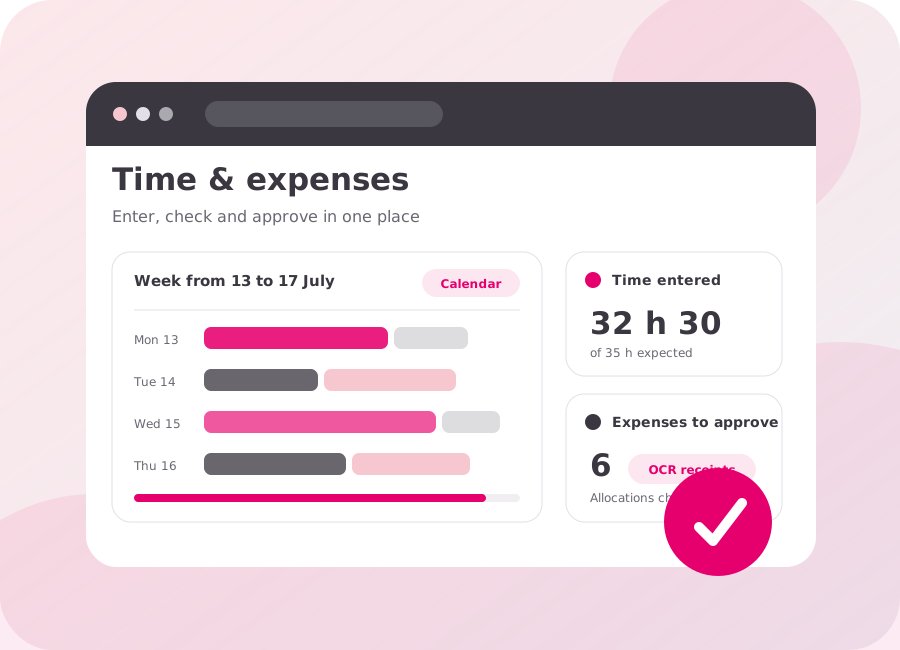
Tempolia makes time entry faster, more intuitive and more secure. It centralises data, makes it available in real time and automates billing, reducing errors. It also saves a considerable amount of time in entering time and analysing projects. The solution also ensures data compliance and security.
Tempolia also stands out for its intuitive, user-friendly operation and the considerable freedom offered by different entry methods across several interfaces, enabling it to meet varied requirements. Tempolia also provides personal assistance through responsive support.
The solution adapts to companies seeking to make their time measurement and billing more reliable. It also connects to a range of industry-specific tools through APIs and evolves regularly with new updates.
Companies required to substantiate time for France’s Research Tax Credit or Innovation Tax Credit gain greater precision and simplify the administrative procedures associated with these tax schemes.
You now offer a cloud-based SaaS solution. Why is that important to your users?
Our users cannot rely on a desktop version alone, and the cloud solution has many advantages. In particular, it provides remote access for teams who are travelling or working from home, while securing data and providing regular backups.
It is also a very simple way to use a solution that is regularly updated in real time and enables several users to work simultaneously.
Organise time entry with your team
- Week 1: define activities, required detail, responsibilities and non-billable cases.
- Week 2: pilot with one team and remove ambiguous or unused choices.
- Week 3: train by role using real working days and introduce a reminder before week-end.
- Week 4: roll out, review exceptions and improve reference data instead of multiplying instructions.
Measure completeness without confusing attendance and activity
| Indicator | Calculation | Interpretation |
|---|---|---|
| Completeness | Hours entered ÷ expected hours | Adjust for leave and work calendars |
| Timeliness | Complete time sheets at D+1 ÷ expected sheets | Measures data availability |
| Median delay | Median time between work and entry | More robust than an average |
| Correction rate | Rows changed after approval ÷ approved rows | Highlights weak rules or training |
| Unallocated time | Hours without valid client, engagement or activity | Prevents useful analysis |
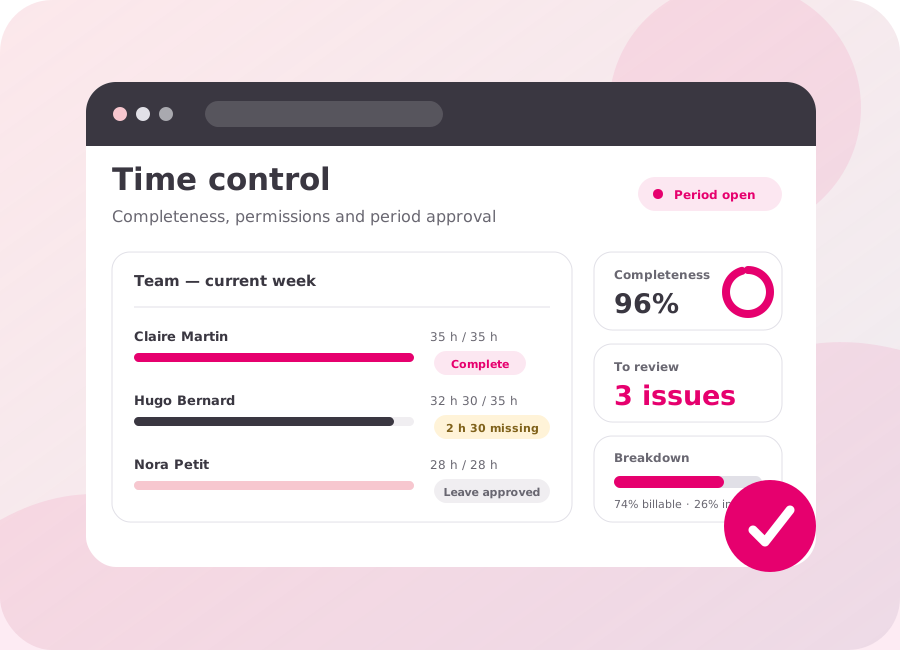
Example: 1,520 expected hours, 1,482 entered and 16 hours of leave not yet included give adjusted completeness of 98.6%: 1,482 ÷ (1,520 − 16). Set an alert threshold, but analyse causes before sending automatic reminders.
See also: calculating engagement profitability and preparing a migration from Excel.