Digital transformation is profoundly changing working methods in accounting firms. Often seen as a response to regulatory requirements and client expectations, it also provides valuable tools for simplifying internal organisation.
Time management plays a vital role among these tools. Yet this essential function remains underestimated and underused in many firms. It is important for improving profitability and can make a real difference.
Why is time management a strategic driver for accounting firms?
Time is a precious, finite resource in an accounting firm. It is directly connected to profitability; it represents not only a cost, but also the added value produced by the firm. In a sector where performance partly depends on optimising resources, effective time management makes all the difference. Here are a few reasons:
- Assess engagement profitability: by tracking time spent on every client accurately, the firm can use recovery analysis to compare the effort involved with the fees invoiced. This identifies engagements with low profitability and allows allocated time or fees to be adjusted where necessary.
- Identify inefficiencies: selected engagements or tasks take too long, are poorly distributed or require more time than expected. Time tracking brings these issues to light.
- Plan effectively: an overview of hours worked makes it possible to adjust workloads when staff are overloaded or underutilised, thereby balancing schedules.
- Strengthen transparency with clients: being able to substantiate time spent on every engagement reinforces client trust and satisfaction.
In short, well-controlled time management improves profitability and client relationships while optimising team performance.

Encourage and support time entry with suitable management tools
Despite its importance, time management is not always straightforward for many firms. It can be complex to implement when the tools used do not meet their requirements.
The first challenge is data accuracy. Staff occupied by numerous tasks forget to record their hours or do so approximately, making analysis less reliable.
Time spent on tracking also creates an additional administrative burden. With manual or unsuitable tools, time management can become lengthy and onerous.
Finally, a lack of overall visibility is a significant problem. Without a centralised system, management struggles to obtain a clear, usable overview of engagements, preventing useful adjustments.
Digital transformation: an answer to time-management constraints
In a highly competitive environment where every hour must deliver value, optimised time management becomes essential. It enables accounting firms to maximise team effectiveness. Often regarded as an administrative detail, it is in fact a decisive advantage for improving profitability and optimising working capital requirements.
Firms invest in digital transformation to overcome these challenges. Supported by suitable tools, time management delivers numerous benefits to accounting firms.
These solutions help guarantee reliable data. Automating time entry and tracking reduces omissions, approximations and human error, improving the quality and relevance of analysis.
Interfaces tailored to different professions make administrative time management quicker and less burdensome for staff.
Tempolia: a complete, integrated solution for accounting firms
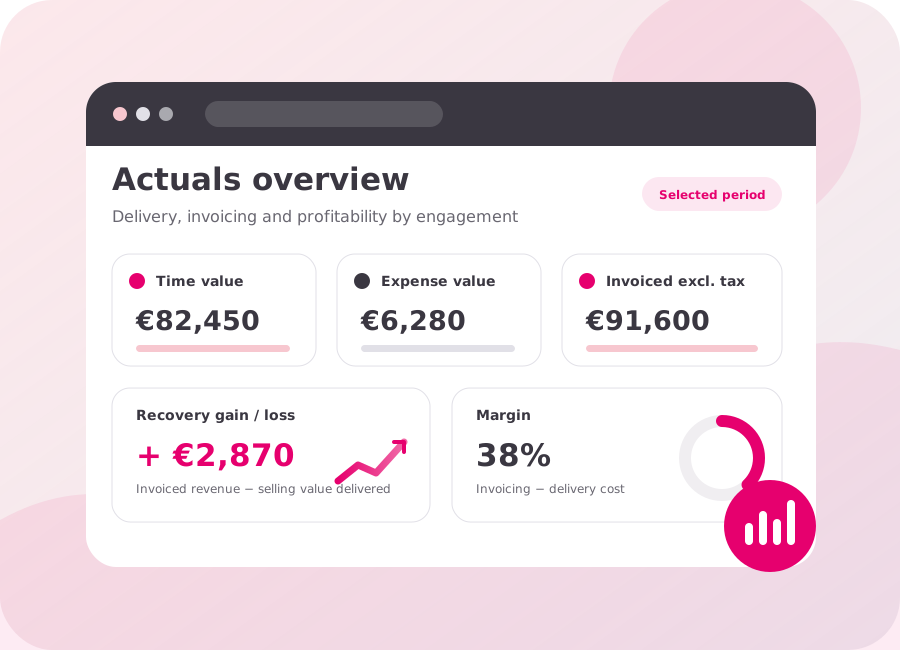
Tempolia provides a complete solution that meets the specific needs of accounting firms and makes time management straightforward and effective. An intuitive interface available on computers and mobile devices lets staff enter hours quickly and accurately. Collected data is centralised automatically, giving managers an up-to-date overall view.
Tempolia also generates detailed summary reports for analysing recovery by engagement.
By integrating time management directly with invoicing modules, Tempolia simplifies every stage of the process. Time tracking, use of time data and invoicing all take place in the same environment, making processes simpler and more reliable.
Tempolia automates and centralises this management while providing complete integration with other business tools. By adopting a comprehensive digital approach, firms gain the means to control their activity more effectively and ensure their long-term sustainability.
See also: calculating engagement profitability and making time entry more reliable.