
Budgeted time / actual time
The budget sets a reference in hours, expenses or value. Actuals are the time, expenses and progress recorded. The variance shows over- or under-consumption; it is neither an invoice nor a receivable.
In service businesses, cash is tied up before invoicing in work in progress and work waiting to be billed, then after invoicing in trade receivables. Tempolia connects actual time and expenses, budgets, the commercial value of work, invoiced amounts, aged receivables and matched payments so that each delay can be managed.
These concepts describe different stages. Reconciling them explains variances; adding them without a valuation rule creates a misleading metric.
The budget sets a reference in hours, expenses or value. Actuals are the time, expenses and progress recorded. The variance shows over- or under-consumption; it is neither an invoice nor a receivable.
The commercial value applies agreed selling rates or rules to actual time and expenses. The invoiced amount is the value included in invoices actually issued. A management value is not automatically recognised revenue.
In Tempolia, boni-mali compares net fees invoiced with the commercial value of actual time and expenses. It explains a billing variance; it measures neither economic margin nor payment.
An operational view of work performed and valued but not yet included in an issued invoice. Tempolia distinguishes what is billable now, what awaits a milestone and what still needs approval.
French account 4181 records income attributable to the period for which an invoice has not yet been issued. An open timesheet, an unfinished engagement or all unbilled operational work does not automatically qualify.
Once recognised, receivables are amounts owed by customers. Ageing separates not-yet-due and overdue balances. Receivables days express a balance in days of revenue; they are not the same as days overdue.
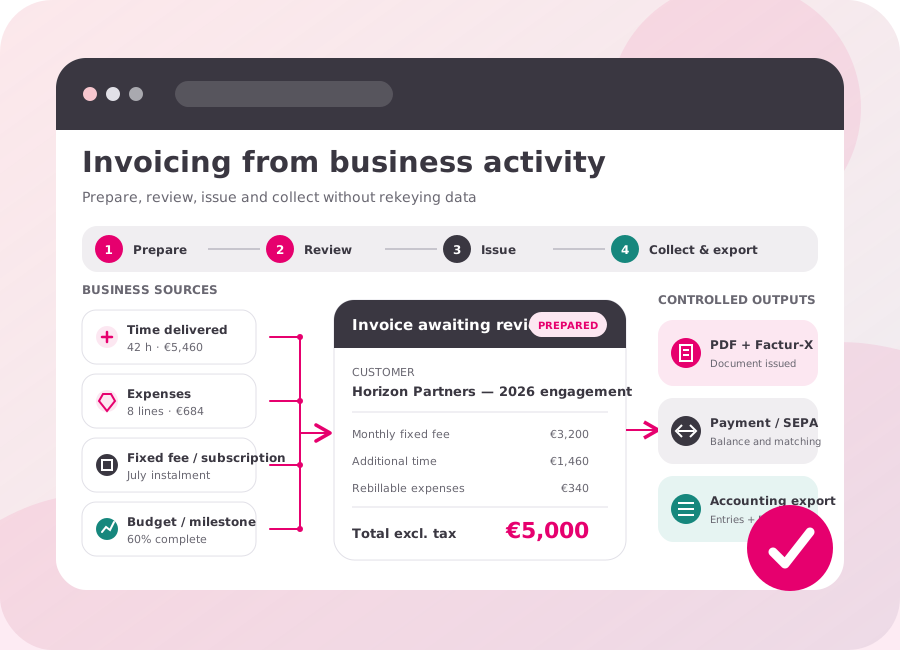
The Tempolia sequence: budget → actual time and expenses → commercial value of work → billable items → invoice issued → not-yet-due or overdue receivable → payment received and matched.
Receivables days alone cannot isolate the waiting time before invoicing. Tempolia separates the operational stages so that each measure remains clear and actionable.
Activity recorded against the correct customer, engagement and period.
Control: entry delay and budget variancePerformed value awaiting approval, evidence, a milestone or preparation.
Control: value, age and reasonIssued invoices that are not yet due, overdue, disputed or promised for payment.
Control: receivables days and ageingCash receipts reconciled with the bank and matched to the correct invoices.
Control: payment-matching timeWork in progress + trade receivablesCustomer advances receivedOperating needs − resources already receivedEstablished reference: this simplified view follows the professional-services example in the Bpifrance Création 2026 guide. Its work in progress represents costs funded before invoicing. Tempolia’s commercial selling value of work answers a different management question.
A management dashboard and the French chart of accounts use different valuation bases. Reconciling them provides a reliable view of work and receivables.
Time, expenses, fixed fees, quantities or milestones valued using a management rule: selling rate, contractual rate or expected amount. This view supports invoice preparation, recovery-variance analysis and budget review.
Class 34 covers service work in progress; account 345 is used for services in progress. The accounting value is based on production cost, including direct labour and a systematic allocation of production overheads.
French chart of accounts 2026 — ANCAccount 4181 records income attributable to the period but not yet invoiced. Depending on the accounting scope, it may form part of “trade receivables and related accounts”. Tempolia keeps it separate from other unbilled-work amounts.
Accounts 418 and 4181 — ANCA clear connection: Tempolia reconciles commercial work value, work in progress, accrued income, invoices, advances, receivables and payments so that every amount has a clear status.

The engagement lead and billing team check completed items, the reached milestone and supporting evidence before issue.
Fast invoicing does not begin with the Issue button. The contract, activity capture, evidence of completion and invoice quality already influence the likely payment date.
Contracting entity, scope, rates, cadence, milestones, purchase order, acceptance evidence, portal, billing contact and payment terms must be known. Agreed billing instructions prevent completed work from waiting for administrative clarification.
Promptly recorded time, expenses, quantities, deliverables and milestones make value visible. Late entry delays invoicing, weakens evidence and increases the risk of omission or dispute.
Every item needs a customer, engagement, date, owner and reason. The next decision becomes explicit: invoice, complete the evidence, obtain approval, wait for the contractual milestone or correct the valuation.
Customer references, VAT, rates, descriptions, period, supporting documents and submission address should be checked before first delivery. A rejected invoice creates rework and delays processing by the customer.
Completion, acceptance, contractual milestone and issue dates must remain distinct. The correct channel and submission statuses show that the invoice entered the expected process.
Receivables days combine agreed terms and late payment. Ageing separates balances not yet due from overdue balances; disputes, payment promises and reminders need an owner and a next-action date.
A payment received but not matched leaves an invoice open and corrupts reminder lists. Matching closes the loop; analysis of rejections, bad debt and billing variances then feeds back into contracts, budgets and invoice preparation.
Finance and the client team qualify the hold-up, assign an owner and set a follow-up date.

A budget overrun, work waiting for its invoice, a rejected invoice and an overdue receivable have neither the same cause nor the same owner. Track these measures by engagement, customer and period to locate value tied up, prioritise action and verify the result. The dictionary below gives the specialist equivalents found in benchmarks.
These are the specialist equivalents of measures used on this page. A more compact supplement then groups other KPIs that are useful for deeper analysis or when reading international benchmarks.
Country, size, customer mix, billing frequency and statistical method materially change the result. Each figure below retains its source population, definition and terminology.
| Population | Measure | Value | Interpretation and scope |
|---|---|---|---|
| Legal practices — Clio 2025 | Recorded work → payment | 93 days | The source separates time before invoicing from collection time. Component medians must not be added to reconstruct the reported overall median. Clio |
| UK accountancy firms — NatWest 2024 | WIP days + debtor days | 105 days | Median revenue-day equivalent for the source’s “total lock-up” metric, not an engagement-level elapsed duration. The pre-invoice phase was 26 days for smaller firms and 41 for larger firms; receivables were 66 and 65 days. NatWest |
| Global professional services — SPI 2025 | Receivables / revenue lost / invoice rework | 43.3 d / 5.3% / 2.1% | 403 organisations, 2024 performance; the study uses DSO, revenue leakage and invoice rework. Architecture and engineering receivables were 59.7 days. SPI report |
| French consulting and business services | Trade receivables | 64.4 days | 57.3 supplier days and a trade credit balance of 39.6 revenue days. |
| France — all firms excluding micro-firms, 2024 | Trade receivables | 41.7 days | Unweighted mean of company-level ratios, closing receivables expressed in days of revenue. Banque de France |
| French manufacturing | Trade receivables | 43.8 days | Same Banque de France method and 2024 population. |
| French construction | Trade receivables | 59.5 days | The trade credit balance was 27.1 revenue days; it cannot be derived by simply subtracting customer and supplier days. |
| French transport and storage | Trade receivables | 50.5 days | Same method, excluding micro-firms. |
| French information and communication | Trade receivables | 71.6 days | 64.1 supplier days and a trade credit balance of 37.4 revenue days. |
How to read these figures: Banque de France ratios cover balance-sheet trade receivables and related accounts; they do not isolate operational waiting time before invoicing and may include accrued income. SPI, NatWest and Clio use different geographies, populations and definitions. An internal trend tracked over time and compared across similar segments — time and materials, fixed fee, subscription or milestone billing — provides the most actionable reference.
Dividing annual revenue by 365 gives a simple order of magnitude. If the combined reduction in work waiting to be billed and receivables represents ten revenue days on a compatible basis, approximately €82k less cash is tied up once the new level is reached.
Assumptions: stable activity and mix, comparable bases, before tax and seasonality effects.
Measure the cash actually released. It is the reduction in unbilled-work and receivables balances, net of changes in advances. Lower financing costs, bad debt, fee write-offs and administration also contribute to profit.
The legal starting point depends on the applicable rule and contract. Completion, acceptance, issue, receipt, due date and payment should therefore remain distinct instead of being treated as one clock.
Default period after performance where no other term is agreed, subject to special regimes.
General cap for negotiated B2B terms from the invoice issue date.
Possible alternative when expressly agreed and not manifestly abusive.
The French DGCCRF also sets out late-payment interest, fixed recovery compensation and sector exceptions. The Payment Terms Observatory recommends agreeing billing, payment and service-acceptance expectations at the start of the relationship. Average French late payment reached 13.6 days beyond due date in Q4 2024; that delay must be distinguished from contractual terms and time to invoice.
Working capital measures a funding need at a reporting date. It does not show whether the need comes from late time entry, work waiting to be billed, contractual terms, payment beyond due date or unmatched cash. Tempolia makes these stages visible separately.
Receivables days are a ratio based on receivables and revenue. They cannot, by themselves, isolate operational work still waiting for an invoice. They also combine contractual terms and lateness; depending on the accounting scope, related accounts may include accrued income.
Not necessarily. Account 345 records services in progress valued at production cost; 4181 concerns income attributable to the period for which an invoice remains to be issued. Tempolia’s commercial work value supports management and may use another basis. Reconciliation in Tempolia explains the differences.
Tempolia keeps the indicators separate to show precisely where value remains tied up. An overall cycle view can then complement the analysis by engagement, customer or cohort.
Build the target from a stable baseline segmented by contract, customer type and billing cadence, then compare like-for-like trends and teams. Fixed-fee, subscription and milestone work should not be forced into one undifferentiated target.
Reducing time before invoicing or payment primarily releases cash. Profit rises only where the process also reduces financing cost, bad debt, fee write-offs, invoicing errors or the administrative cost of rework and disputes.
Give every value one status on the measurement date. Tempolia connects commercial work value, accrued income, issued invoices, receivables and matched payments so that each amount is tracked once.
Tempolia makes controllable causes visible and actionable: late entry, omitted items, approval queues, incomplete invoices, unmonitored due dates, ownerless disputes, untracked reminders and unmatched payments.
 Topic Brochure
Unbilled work, aged receivables, payments and reminders in one workflow.
Open the PDF Topic Brochure
Compare budgets, actual costs, fees and billing variances for each engagement.
Open the PDFThe demonstration starts with your billing model and follows a real cycle: budget, actual time and expenses, commercial work value, billable items, issue, due date, payment, matching and reminder.