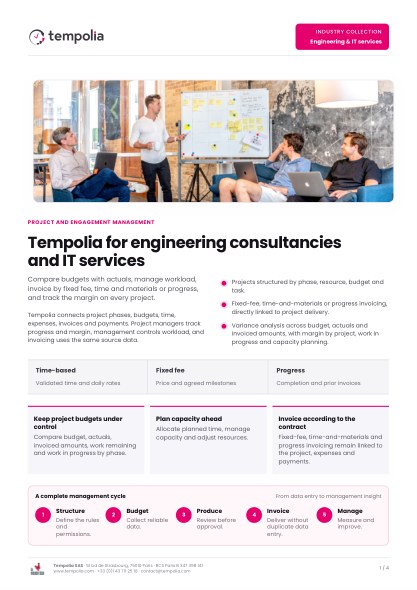
Use time and materials when scope can change and the client agrees to pay for resources consumed. Use a fixed fee when the outcome and scope are sufficiently defined. Use progress billing when value is delivered through measurable phases. One contract can combine these methods, but every line needs a rule, evidence and an owner.

Choose a method that fits the work
| Method | Prefer it when | Main risk | Control |
|---|---|---|---|
| Time and materials | The requirement evolves and time units are verifiable | Unapproved time or exceeded cap | Approved time sheets, cap and rates |
| Fixed fee | Deliverables, scope and assumptions are defined | Effort overrun and free additional work | Budget, work to complete, changes and margin |
| Progress | Phases or milestones represent delivered value | Subjective percentage or billing ahead | Completion criteria and project-manager approval |
Bill time and materials without late disputes
The contract states the unit, rates, profiles, rechargeable expenses, cap and approval path. Obtain time approval at a frequency suited to the project. Monthly approval on billing day leaves too little time to correct an incomplete narrative or out-of-scope activity.
Example: 12 consultant days at €850 and three project-manager days at €1,050 produce €13,350 excluding tax. Reconcile submitted, approved and billed days. Qualify any variance instead of silently deleting it.
Protect fixed-fee margin
A fixed fee transfers part of the productivity risk to the supplier. Break it into work packages with hours or cost budget, owner, date, assumptions and work to complete. Margin identified after delivery is too late: forecast margin at completion whenever work to complete changes.
Forecast margin at completion = contract price − actual cost − estimated cost to complete.
New requests follow a separate path: qualify, estimate, approve, contract change or order, then bill. The additional work guide describes this process.
Measure defensible progress
Do not confuse hours consumed with technical progress. A phase can have consumed 70% of its budget but be only 50% complete. Define the method: accepted milestones, delivered units or an estimate of work performed approved by the responsible manager. For a €100,000 contract at 45% completion, with €30,000 already billed, the progress invoice is €15,000 excluding tax before retention or other contractual rules.

Handle payments on account, work to complete and changes
- A payment on account supports cash flow; on its own, it does not measure progress.
- Work to complete is a revised operational estimate, not the mechanical balance of the budget.
- A contract change preserves the link between request, price, timing and responsibility.
- A draft invoice remains separate from the issued invoice and reviewable before approval.
See also: billing and payments, profitability management and the Tempolia operational FAQ.